Showing posts with label grassland. Show all posts

Thursday, 30 July 2015

Summer Posterchild

"Summer Posterchild"

The gold and green vista of an English meadow was once a common sight in Summer. Such a sight is much rarer now, as 97% of the UK's meadows have been lost since World War II. This photo was taken at Langdon Hills Country Park in Essex, part of the Langdon Living Landscape. The Country Park's meadows are varied; some were improved for agriculture in the past and are gaining in wildlife interest through appropriate management, while some fields were already glorious with wildflowers. Three of the fields are important enough to be designated as Sites of Special Scientific Interest.

Saturday, 23 May 2015

Langdon Hills: Feeling Blue

"Feeling Blue" by Heenan Photography
"Feeling Blue": Common Blue Butterfly, Langdon Hills, Essex
A rather ragged-looking blue butterfly rests a moment in one of the wildflower meadows of Langdon Hills Country Park, near Basildon in Essex.

The larvae of this butterfly feed on Bird's-foot Trefoil (Lotus corniculatus). Adults will also feed on Bird's-foot Trefoil, and a variety of other plants besides (read more at www.ukbutterflies.co.uk).

Many of the butterflies in the Lycaenidae family have interesting relationships with ants. The chrysalis of the Common Blue attracts ants that protect it from predators. Larvae can also produce nutrients to feed ants (read more on Wikipedia).

Saturday, 2 August 2014

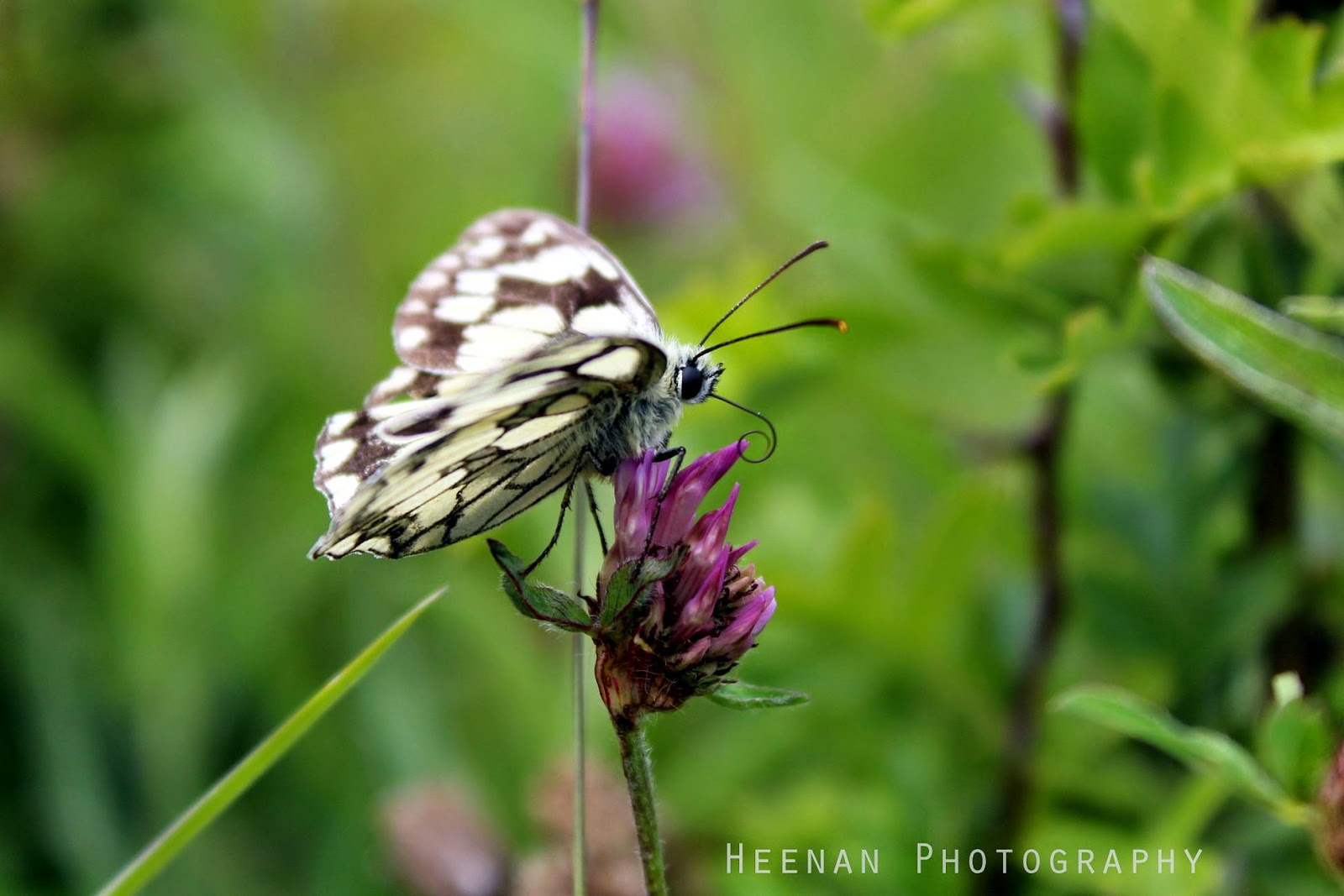
Marbled White at Langdon Hills


This shot captures a Marbled White butterfly, feeding on red clover at Langdon Hills Country Park, in Thurrock (Essex). The site has a number of meadows, supporting a myriad of insects and other wildlife - including 33 species of butterfly. Many of these are on the wing now that the British summer is most definitely here. Below we have some more information about the Marbled White butterfly, from Naturalist Natasha Lodge.
- Tom Heenan, Photographer

The Marbled White (Melanargia galathea) is actually more closely related to the 'Brown' butterflies than the 'White' butterflies due to its life cycle and habits. It has distinct black and white markings that make it easy to recognise. Small, red, parasitic mites are often seen on the bodies of Marbled Whites, but these do not pose a threat to the butterfly in small numbers and do not detract from their attractive colouring. It is a common species and is found throughout most of South and central England and in parts of South Wales. It is currently absent from Scotland, however the species is expanding northwards.
- Natasha Lodge, Naturalist

Saturday, 7 June 2014

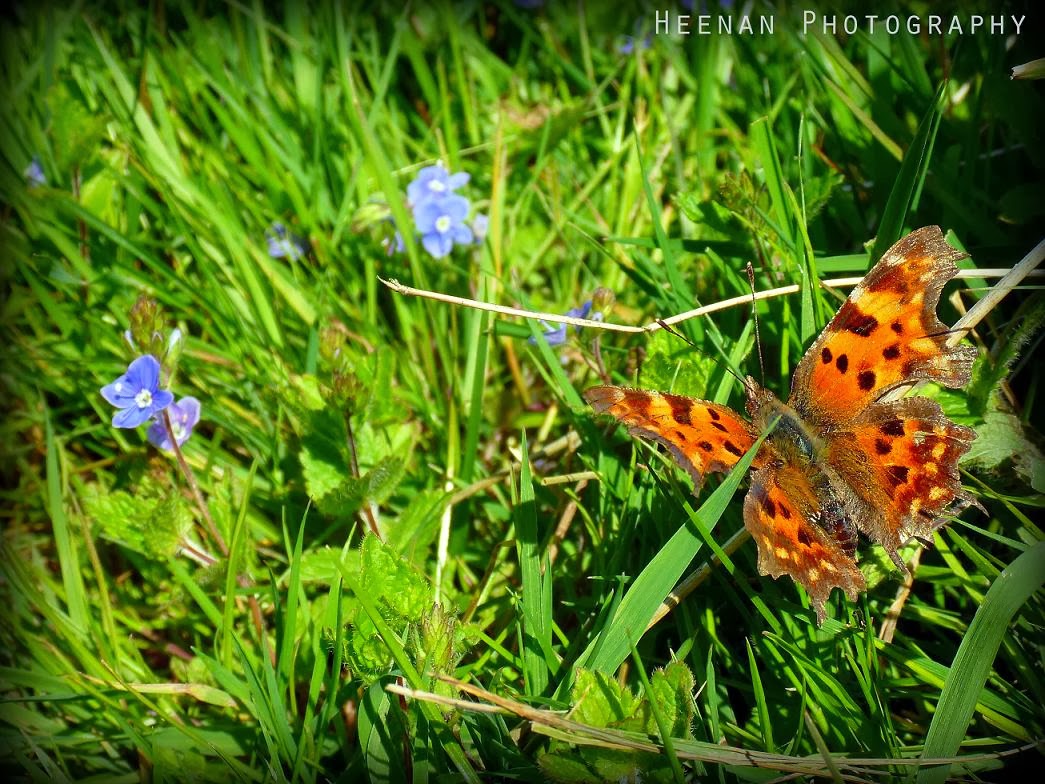
Fading Comma

"Fading Comma", resting amongst the Speedwell flowers, May 2013.

The sun is finally shining on us here in the UK, or so it seems. The butterflies are making the most of the bright weather, with many of these bold and beautiful creatures flying around the woodlands and meadows of the countryside, or visiting gardens. Here is a shot from last Summer, of an old Comma butterfly, starting to look ragged but still beautifully coloured, resting on the grass amongst the Speedwell flowers. This shot was taken on the walk between Admiral's Park in Chelmsford and the village of Writtle.

Germander Speedwell (Veronica chamaedrys) is an interesting flower. Some attribute the name "Speedwell" to its use as a traditional remedy, where it was supposed to cure a person quickly (see article here). It may not be enough to restore the Comma butterfly in the face of climate change however.

The Comma butterfly, and other darker insects like it, may soon be fading away as a result of climate change. A study published last month found that global warming is favouring lighter coloured insects over darker ones; Zeuss et al. looked at a wide range of butterfly and dragonfly species across Europe and found that their colouring affects their ability to cope with temperature. The current distribution of these insects is linked to their colouring, and as temperature increases their distribution will too. Darker insects, like the Comma, retreat northwards and lighter insects appear in their place. “Until now we could only watch the massive changes in the insect fauna during the last 20 years. Now we have an idea of what could be a strong cause of the changes," said Dirk Zeuss, lead author of the study. This will help to predict future changes to insect populations in Europe.

ShareThis

Related Posts Plugin for WordPress, Blogger...